No business should depend on the knowledge held by just one person.
The Knowledge Risk Audit™ helps founder-led, knowledge-heavy small to medium sized businesses find where critical decisions, client context, delivery standards, and operating know-how are trapped in the heads of the founder and a few indispensable people...then turns that risk into a prioritized 90-day action plan.
Most founders start this conversation after a key person leaves, an attempt to delegate goes awry, or a delivery problem exposes how much of the business still lives in one person's head.
Built on a methodology developed from KM policy architecture, mission-critical systems leadership, and organizational learning practice.



It doesn't look like a knowledge problem.
It just feels like friction.
Do these sound familiar?
Too many decisions still route back to the founder.
Senior experts are overloaded.
New managers keep escalating decisions.
New hires ramp slowly.
Delivery quality changes depending on who is assigned.
Critical client or system knowledge has no backup owner.
The business runs on memory, exceptions, Slack history, and "ask Sarah."
The company looks organized on paper. Work moves. Information flows. But the right decisions still depend on the people who know the unwritten rules.
What’s missing is context and judgment.
This isn't about documentation...
you're suffering from a knowledge dependency problem.
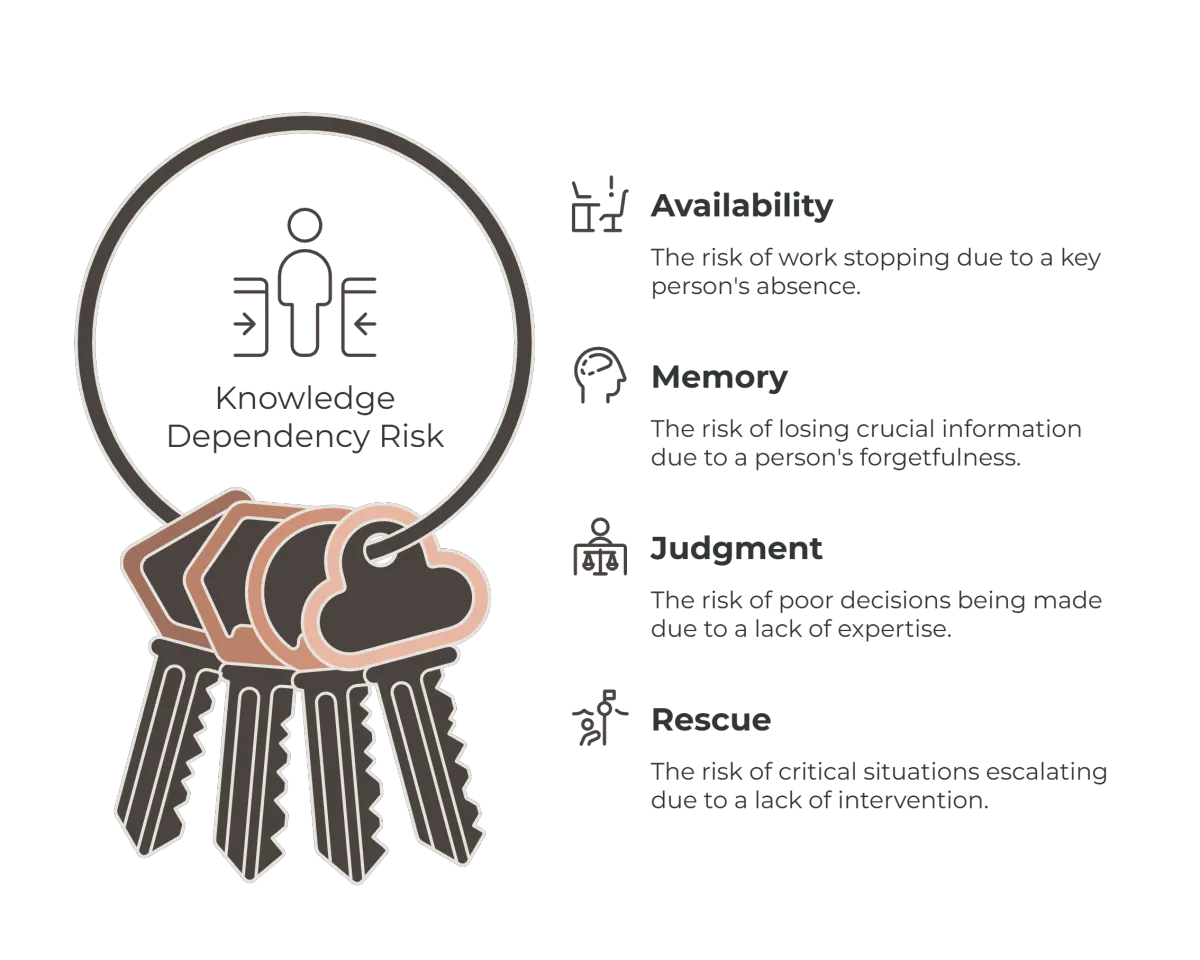
Documentation is about storage. Knowledge dependency is about the context and judgement hidden in your business culture. It's the unwritten operating system that determines who knows how to do what, who makes the call when it matters, and what happens when that person is not there.
Knowledge Dependency
A company has knowledge dependency risk when the business needs the same person to remember the context, make the judgment call, or rescue the work.
You don't need to document everything.
You just need to identify the knowledge dependencies with the most business risk,
then systematize the context and the judgement needed, focusing on the most critical first.
This is not a wiki cleanup.
Documentation projects start with the question...
"What haven't we written down?"

The Knowledge Risk Audit™ starts with the question...
"Where are the people dependencies, broken processes, and weak tools that make the business less scalable, less transferable, or less valuable?"
A documentation project produces pages.
A Knowledge Risk Audit™ reveals where the business depends on undocumented judgment, fragile handoffs, and a few indispensable people.
The Knowledge Risk Audit™
A 4-week strategic audit for founder-led, knowledge-heavy SMBs that need to reduce founder bottlenecks, key-person dependency, and inconsistent delivery before those risks limit growth, succession, or enterprise value.
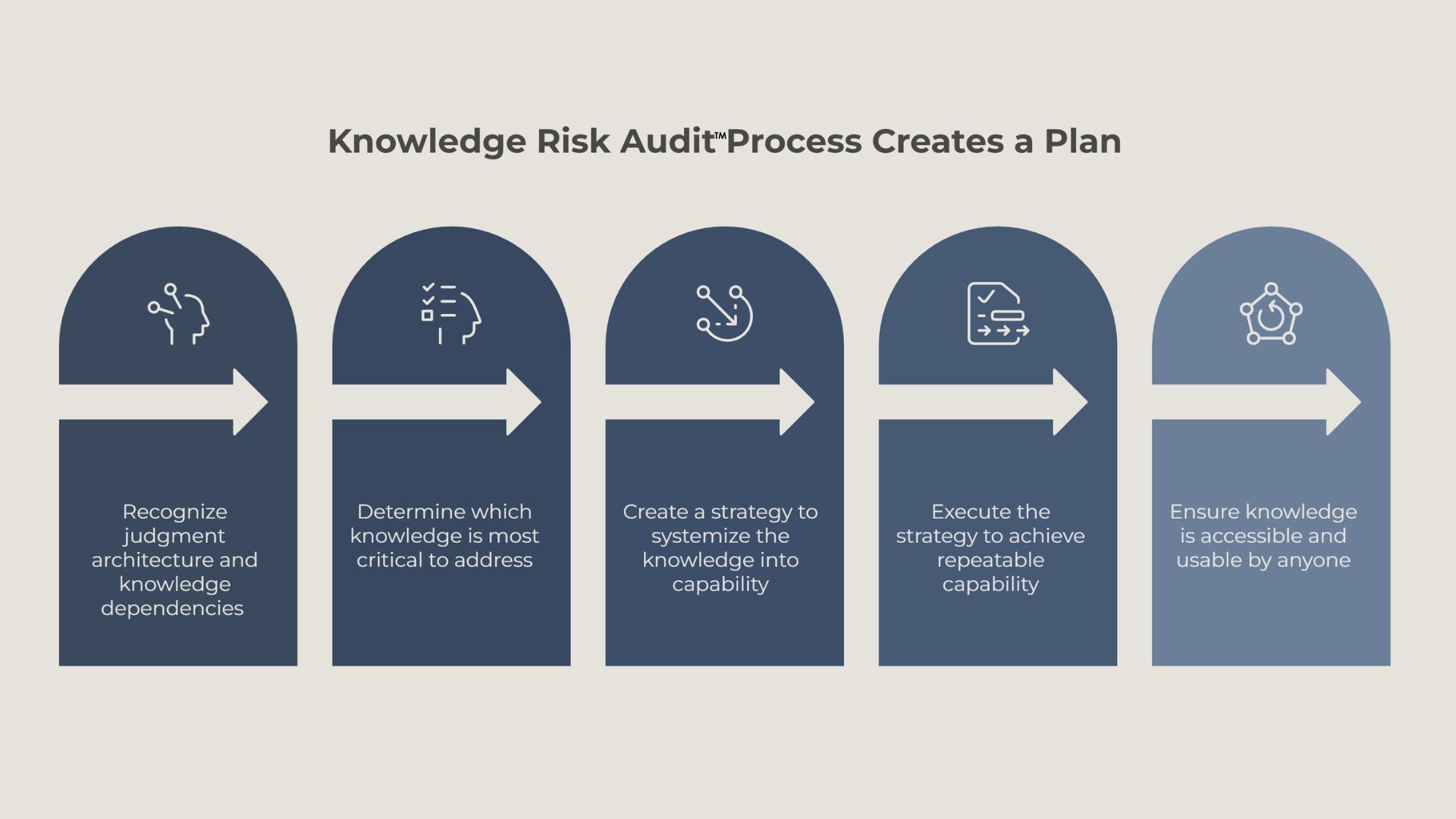
The outcome is not better documentation, it's a prioritized plan to turn fragile, person-dependent knowledge into repeatable operating capability.
For a company doing $5M–$25M in revenue, the cost in rework, ramp time, founder rescue work, and reduced succession readiness, of unresolved knowledge dependency is almost always larger than the cost of addressing it. This engagement is priced as a business-risk and growth-leverage investment, not an administrative expense. Fixed-fee engagements start at $9,500.00.
The audit is built for companies that need to spread out the judgement and context knowledge of key people.
Best fit:
Founder-led or owner-led SMBs
Expert-dependent companies
Usually 25–75 employees
Often $5M–$25M in revenue
Examples include: Professional services, technical services, IT/MSP, consulting, engineering-heavy, GovCon-adjacent, software/SaaS services, fintech, data-heavy, or expert-led firms.
Especially relevant when:
A key person recently left, threatened to leave, burned out, or became overloaded.
The founder tried to delegate but decisions still came back.
Delivery inconsistency is creating rework, margin loss, client complaints, or founder rescue work.
The company is preparing for growth, succession, exit, or leadership transition.
What the Audit Produces
Knowledge Risk Map
A structured view of where critical knowledge lives, who owns it, and where the business is exposed.
Founder Bottleneck & Escalation Analysis
A breakdown of where decisions, approvals, exceptions, and rescue work still route back to the founder or senior experts.
Key-Person Dependency Scorecard
A prioritized view of indispensable roles, fragile knowledge areas, backup gaps, and risk severity.
Operating Knowledge Opportunity Roadmap
A ranked list of the highest-leverage knowledge systems, decision frameworks, learning loops, role backups, or operating practices to build first.
Executive Briefing & 90-Day Action Plan
A concise leadership report and live debrief that translates findings into practical next steps.
Founder Bottleneck & Escalation Analysis
A breakdown of where decisions, approvals, exceptions, and rescue work still route back to the founder or senior experts.
How the Audit Works
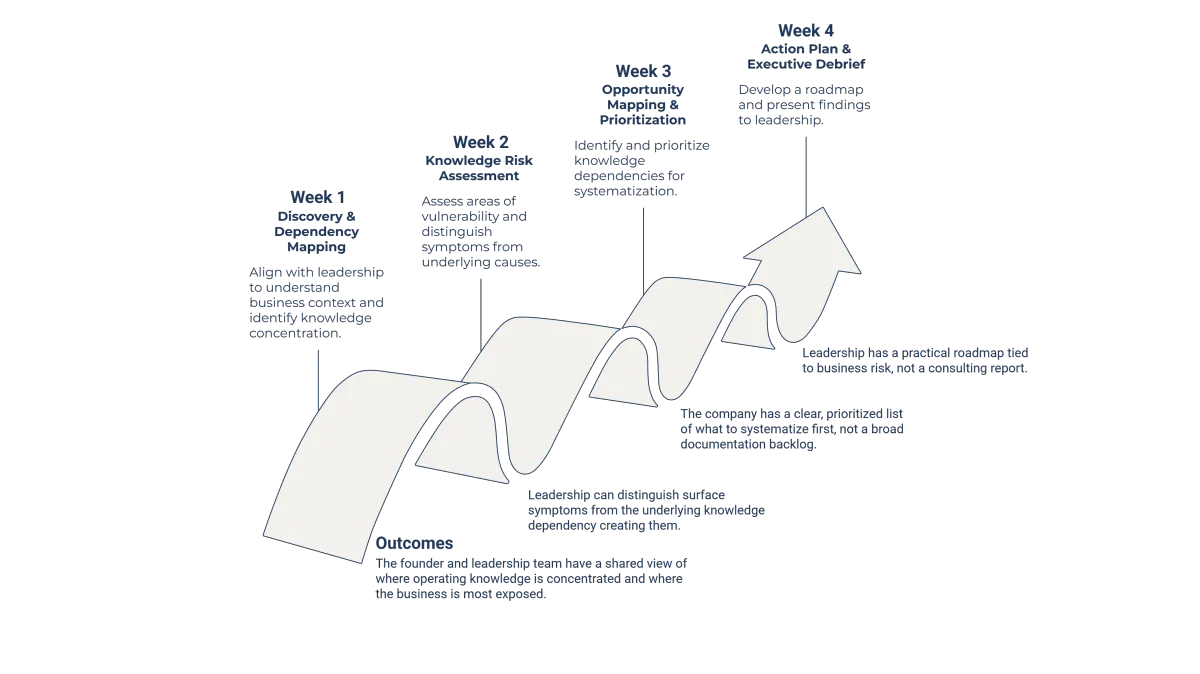
Can be done in four phases instead of four weeks depending on the size of the audit.
Good Fit / Poor Fit
Good Fit
Founder is still too involved in routine decisions.
Key people hold too much critical knowledge.
Delivery quality varies by person or team.
New managers keep escalating decisions.
Business is preparing for growth, succession, exit, or leadership transition.
Rework, ramp time, or client inconsistency is creating economic pain.
Poor Fit
You only want someone to organize files.
There is no visible growth, turnover, delegation, or delivery pressure.
Founder or senior decision-maker is not involved in the conversation.
The team wants SOPs but not behavior change.
There is no budget or urgency.
The company is comfortable with heroics and workarounds.
FAQs
Answers to Your Key Questions on Protecting Intellectual Assets
What exactly is a Knowledge Risk Audit?
A Knowledge Risk Audit is a comprehensive review designed to protect and maximize your company's intellectual assets.
How often should we conduct a Knowledge Risk Audit?
We recommend conducting a full audit annually, with more frequent reviews depending on changes in business model, technology, and regulation.
What are the benefits of assessing our Knowledge Management Systems
Assessing your systems helps pinpoint areas where knowledge leakage occurs, optimizes information flow, and boosts overall operational efficiency and innovation.
Can Knowledge Risk Audit assist with litigation concerning intellectual property
While we focus on auditing and preventive measures, we can provide documentation and assessments that may assist your legal team in intellectual property litigation.
Is our data safe with you during the audit process?
Absolutely. We ensure data integrity and security through strict confidentiality agreements and robust security protocols.
What differentiates Knowledge Risk Audit from other consultancy services
We specialize in knowledge risk, combining expertise in intellectual property, data security, and competitive intelligence.
Find out where your business is most exposed before a trigger event forces you to.
The first step is a 30-minute fit call. We will look at what is happening in the business, what triggered the concern, and whether the Knowledge Risk Audit™ is the right next move. You will leave the call with clarity about your highest-risk knowledge dependency regardless of whether we work together.